1. Introduction & Overview
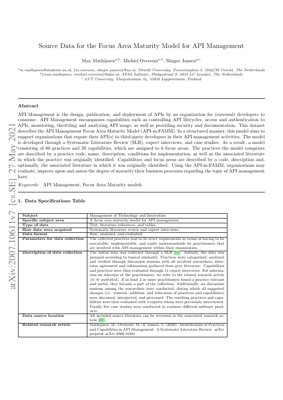
This document presents the dataset and foundational analysis for the API Management Focus Area Maturity Model (API-m-FAMM). The model is designed to provide organizations that expose APIs to third-party developers with a structured framework to evaluate, improve, and assess the maturity of their API management business processes. API Management is defined as the activity encompassing the design, publication, deployment, and ongoing governance of APIs, including capabilities like lifecycle control, access management, monitoring, throttling, analytics, security, and documentation.
The primary value of this dataset lies in its rigorous, multi-method derivation, offering a consolidated view of proven practices essential for effective API strategy execution.
2. Data Specifications & Methodology
The dataset is a product of a robust, multi-phase research methodology ensuring both academic rigor and practical relevance.
2.1 Data Acquisition & Sources
Subject Area: Management of Technology and Innovation, specifically Focus Area Maturity Models for API Management.
Data Type: Textual descriptions, literature references, and structured tables detailing practices and capabilities.
Primary Source: A Systematic Literature Review (SLR) [68], supplemented by grey literature.
2.2 Data Collection Process
The collection followed a stringent, iterative process:
- Initial SLR & Categorization: Practices were identified from literature and grouped by topical similarity.
- Internal Validation: Researcher discussion sessions, inter-rater agreement checks, and analysis.
- Expert Validation (11 interviews): Practices and capabilities were evaluated by practitioners. A practice was retained if deemed relevant and useful by at least two experts.
- Refinement (6 discussion sessions): Researchers discussed and processed additions, removals, and relocations.
- Final Evaluation: The refined set was evaluated by 3 previously interviewed experts.
- Case Study Validation: Five case studies on different software products were conducted for final evaluation.
3. The API-m-FAMM Framework
3.1 Core Components: Practices, Capabilities, Focus Areas
The model is hierarchically structured into three core components:
- Practices (80): The atomic, executable actions an organization can implement. Each practice is described by a unique code, name, description, conditions for implementation, and source literature.
- Capabilities (20): Higher-level competencies formed by grouping related practices. Described by a code, description, and optional source literature.
- Focus Areas (6): The top-level domains of API management, each encompassing a set of capabilities. They provide strategic direction for maturity assessment.
3.2 Model Structure & Hierarchy
The model follows a clear hierarchy: Focus Area → Capability → Practice. This structure allows organizations to drill down from strategic domains to specific, actionable tasks. The six focus areas (e.g., likely covering areas like Strategy & Design, Development & Deployment, Security & Governance, Monitoring & Analytics, Community & Developer Experience, Lifecycle Management) provide a comprehensive view of the API management landscape.
4. Key Insights & Statistical Summary
Total Practices
80
Actionable, implementable items
Core Capabilities
20
Grouped competencies
Strategic Focus Areas
6
Top-level management domains
Validation Interviews
11+3
Expert validation rounds
Primary Use Cases:
- Researchers: For model evaluation, validation, extension, and establishing field vocabulary.
- Practitioners/Consultants: To assess implementation completeness of practices and guide maturity improvement roadmaps.
5. Original Analysis: A Critical Industry Perspective
Core Insight: The API-m-FAMM isn't just another academic taxonomy; it's a rare, practitioner-validated blueprint that bridges the notorious gap between API theory and operational reality. In a market flooded with vendor-specific frameworks (like Google's Apigee or MuleSoft's maturity models), this work provides a vendor-agnostic, evidence-based foundation. Its rigor—echoing the methodological discipline seen in foundational SLRs in software engineering like those by Kitchenham et al.—is its greatest asset. However, its true test lies not in its construction but in its adoption against entrenched, often siloed, organizational processes.
Logical Flow: The model's logic is impeccably sound: decompose the monolithic problem of "API management" into Focus Areas (the "what"), define Capabilities within them (the "how well"), and specify Practices (the "how to"). This mirrors the Goal-Question-Metric (GQM) approach used in measurement-based software engineering. The validation flow—from literature to expert consensus to case studies—is robust, similar to the multi-stage validation processes employed in developing the SPICE or CMMI models.
Strengths & Flaws: Its principal strength is its empirical grounding. Unlike many maturity models that are conceptual or based on limited case studies, the API-m-FAMM's 80 practices are distilled from broad literature and ratified by 11+3 experts. This gives it immediate credibility. A significant flaw, however, is implicit: the model assumes a level of organizational coherence and API-centric strategy that many companies lack. It maps the destination but is light on the change management toolkit needed for the journey—a common critique of maturity models highlighted by researchers like Paulk and Becker. Furthermore, while the practices are listed, the interdependencies, implementation sequencing, and resource trade-offs are not explicitly modeled, which are critical for practical roadmap planning.
Actionable Insights: For leaders, the model's primary value is as a diagnostic and prioritization tool. Don't attempt to implement all 80 practices at once. Use the 6 Focus Areas to identify your organization's greatest pain points (e.g., is it Security or Developer Experience?). Then, assess maturity within that area using the specific practices as a checklist. This targeted approach aligns with the concept of "continuous and staged" models discussed in ISO/IEC 330xx. The data set is a starting point for building a customized, metrics-driven improvement plan. The next step for any team should be to overlay this model with their own API usage metrics and business objectives to create a weighted, context-sensitive maturity scorecard.
6. Technical Details & Analytical Framework
6.1 Maturity Scoring & Assessment Logic
While the PDF does not specify a scoring algorithm, a typical maturity model assessment can be formalized. The maturity level $M_{FA}$ for a Focus Area $FA$ can be derived from the implementation status of its constituent practices. A simple weighted scoring approach could be:
$M_{FA} = \frac{\sum_{i=1}^{n} w_i \cdot s_i}{\sum_{i=1}^{n} w_i} \times L_{max}$
Where:
- $n$ is the number of practices in the Focus Area.
- $w_i$ is the weight (importance) of practice $i$ (could be derived from expert ratings).
- $s_i$ is the implementation score for practice $i$ (e.g., 0=Not Implemented, 0.5=Partially, 1=Fully).
- $L_{max}$ is the maximum maturity level (e.g., 5).
The overall organizational maturity $M_{Org}$ could then be an aggregate, perhaps a vector of the six $M_{FA}$ scores to avoid losing granularity: $M_{Org} = [M_{FA1}, M_{FA2}, ..., M_{FA6}]$.
6.2 Framework Application: A Non-Code Case Example
Scenario: A fintech company "PayFast" has a public API for payment processing but struggles with developer complaints about reliability and unclear documentation.
Analysis using API-m-FAMM:
- Identify Relevant Focus Area: Symptoms point to "Developer Experience & Community" and "Monitoring & Analytics".
- Assess Capabilities & Practices: Within Developer Experience, assess practices like:
- "Provide interactive API documentation (e.g., Swagger UI)"
- "Maintain a public changelog for API versions."
- "Offer a sandbox environment with test data."
PayFast finds it has no changelog and a limited sandbox.
- Prioritize Actions: Based on the model's structure and expert-validated importance (implied by inclusion), PayFast prioritizes creating a changelog and enhancing its sandbox as quick wins to improve developer trust, before delving into more complex monitoring capabilities.
This structured assessment moves the team from vague "improve docs" to specific, actionable tasks validated by industry experts.
7. Application Outlook & Future Directions
The API-m-FAMM dataset opens several avenues for future work and application:
- Tooling Integration: The structured data is ideal for integration into API management platforms (e.g., Kong, Azure API Management) as a built-in assessment module, providing automated maturity dashboards.
- Dynamic Maturity Models: Future research could link the implementation of practices to operational metrics (e.g., API uptime, mean time to resolution, developer onboarding time) to create a data-driven, self-adjusting maturity model. This aligns with the DevOps research on measuring and improving software delivery performance.
- Vertical-Specific Extensions: The model is generic. Future work could create tailored extensions for industries like healthcare (HIPAA-compliant API practices) or finance (PSD2/Open Banking specific capabilities), similar to how CMMI has domain-specific variants.
- Quantitative Benchmarking: Aggregating and anonymizing assessment data from multiple organizations could create industry benchmarks, answering the critical question: "How mature are we compared to our peers?"
- AI-Powered Gap Analysis: Leveraging LLMs trained on the practice descriptions and organizational API portals/documentation could enable semi-automated initial maturity assessments, significantly lowering the barrier to entry for using the model.
8. References
- Mathijssen, M., Overeem, M., & Jansen, S. (2020). Identification of Practices and Capabilities in API Management: A Systematic Literature Review. arXiv preprint arXiv:2006.10481.
- Kitchenham, B., & Charters, S. (2007). Guidelines for performing Systematic Literature Reviews in Software Engineering. EBSE Technical Report, EBSE-2007-01.
- Paulk, M. C., Curtis, B., Chrissis, M. B., & Weber, C. V. (1993). Capability Maturity Model for Software, Version 1.1. Software Engineering Institute, CMU/SEI-93-TR-24.
- Becker, J., Knackstedt, R., & Pöppelbuß, J. (2009). Developing Maturity Models for IT Management. Business & Information Systems Engineering, 1(3), 213–222.
- ISO/IEC 330xx series. Information technology — Process assessment.
- Forsgren, N., Humble, J., & Kim, G. (2018). Accelerate: The Science of Lean Software and DevOps: Building and Scaling High Performing Technology Organizations. IT Revolution Press.
- [68] The associated primary research article from the Systematic Literature Review (referenced in the PDF).