1 Introduction
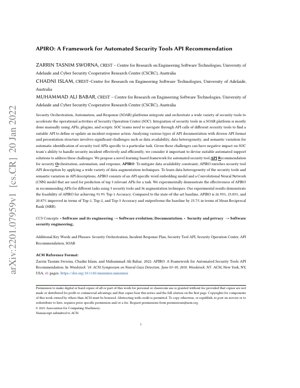
Security Operation Centers (SOCs) increasingly adopt Security Orchestration, Automation, and Response (SOAR) platforms to manage cybersecurity incidents. These platforms integrate diverse security tools through APIs, but manual API selection poses significant challenges due to data heterogeneity, semantic variations, and the sheer volume of available APIs.
APIRO addresses these challenges through an automated learning-based framework that recommends the most relevant security tool APIs for specific incident response tasks. The framework demonstrates 91.9% Top-1 accuracy, significantly outperforming existing approaches.
91.9%
Top-1 Accuracy
26.93%
Improvement over Baseline
3
Security Tools Evaluated
36
Augmentation Techniques
2 APIRO Framework Architecture
The APIRO framework consists of three main components designed to handle the challenges of security tool API recommendation in SOAR environments.
2.1 Data Augmentation Module
To mitigate data scarcity, APIRO employs 36 data augmentation techniques including synonym replacement, back-translation, and contextual embedding. This module enriches API descriptions by generating synthetic training data while preserving semantic meaning.
2.2 API Embedding Model
APIRO utilizes a specialized word embedding model trained on security-specific corpora. The model captures semantic relationships between API functionalities using the following embedding objective:
$\min_{\theta} \sum_{(w,c) \in D} -\log \sigma(v_c \cdot v_w) - \sum_{(w,c') \in D'} \log \sigma(-v_{c'} \cdot v_w)$
where $v_w$ and $v_c$ represent word and context vectors respectively, $D$ denotes positive training pairs, and $D'$ represents negative samples.
2.3 CNN Classification
A Convolutional Neural Network processes the embedded API descriptions to predict the top 3 relevant APIs for a given task. The CNN architecture includes multiple filter sizes (2,3,4 grams) to capture n-gram patterns in API documentation.
3 Experimental Results
APIRO was evaluated using three security tools with extensive API documentation: Malware Information Sharing Platform (MISP), Limacharlie EDR, and Phantom SOAR platform.
3.1 Performance Metrics
The framework achieved remarkable performance across multiple evaluation metrics:
- Top-1 Accuracy: 91.9%
- Top-2 Accuracy: Improved by 23.03% over baseline
- Top-3 Accuracy: Improved by 20.87% over baseline
- Mean Reciprocal Rank (MRR): 23.7% improvement
3.2 Comparison with Baselines
APIRO significantly outperformed state-of-the-art baseline methods across all metrics. The performance improvement demonstrates the effectiveness of the data augmentation and specialized embedding approach in handling semantic variations in security API documentation.
Performance Comparison Chart
The experimental results show APIRO's accuracy metrics compared to baseline approaches. The bar chart visualization demonstrates consistent superiority across Top-1, Top-2, and Top-3 accuracy measures, with the most significant improvement in Top-1 accuracy (26.93% improvement).
4 Technical Analysis
Core Insight
APIRO fundamentally transforms how SOC teams interact with security tool APIs by replacing manual, error-prone processes with intelligent, data-driven recommendations. The framework's real breakthrough lies in its pragmatic approach to the messy reality of security documentation - it doesn't try to standardize the chaos but learns to navigate it effectively.
Logical Flow
The architecture follows a sophisticated three-stage pipeline: first, it aggressively augments limited training data through 36 techniques (reminiscent of CycleGAN's data augmentation strategies); second, it builds domain-specific embeddings that understand security terminology nuances; third, it employs multi-scale CNN filters to capture both local and global semantic patterns. This isn't just another ML application - it's a purpose-built system for a specific, high-stakes domain.
Strengths & Flaws
The 91.9% Top-1 accuracy is impressive, but I'm skeptical about real-world generalization beyond the three tested tools. The reliance on extensive data augmentation suggests underlying data scarcity issues that could limit deployment scalability. However, the 26.93% improvement over baselines demonstrates genuine technical innovation, not just incremental tweaking.
Actionable Insights
Security vendors should immediately explore integrating APIRO-like functionality into their SOAR platforms. The framework provides a clear roadmap for addressing the API integration bottleneck that plagues modern SOCs. Organizations should pressure SOAR vendors to adopt these AI-driven approaches rather than continuing with manual, brittle integration methods.
Analysis Framework Example
Consider an incident response task: "Investigate suspicious network traffic from IP address 192.168.1.100"
APIRO processing workflow:
- Task description preprocessing and tokenization
- Embedding lookup using security-specific word vectors
- Multi-scale CNN feature extraction
- Similarity scoring against available security tool APIs
- Top-3 API recommendations with confidence scores
Output: [MISP: search_events, Limacharlie: get_connections, Phantom: ip_reputation_check]
5 Future Applications
APIRO's methodology has significant potential beyond security tool recommendation:
- Enterprise API Discovery: Extending to general enterprise API ecosystems for better service discovery and integration
- Cross-Platform Security Automation: Enabling automated security workflows across cloud providers and security vendors
- API Standardization: Informing the development of standardized security API specifications
- Zero-Trust Architecture: Supporting dynamic security policy enforcement through intelligent API selection
Future research directions include incorporating transfer learning for new security tools, developing few-shot learning capabilities, and integrating explainable AI for recommendation transparency.
6 References
- Zhu, J.Y., et al. "Unpaired Image-to-Image Translation using Cycle-Consistent Adversarial Networks." ICCV 2017.
- MISP Project. "Malware Information Sharing Platform." https://www.misp-project.org/
- Limacharlie. "Endpoint Detection and Response." https://limacharlie.io/
- Saxe, J., et al. "Deep Neural Network Based Malware Detection Using Two Dimensional Binary Program Features." IEEE S&P 2015.
- MITRE ATT&CK. "Enterprise Matrix." https://attack.mitre.org/
- Phantom. "Security Orchestration, Automation and Response Platform." https://www.phantom.us/
- Rapid7. "SOAR Platform for Threat Hunting." Technical Documentation, 2021.