1. Introduction & Overview
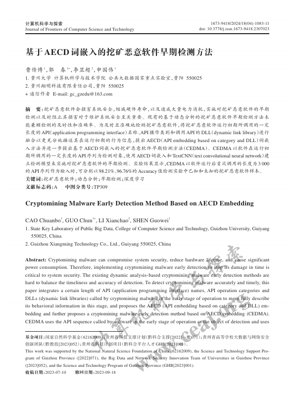
Cryptomining malware poses a significant threat to system security, causing hardware degradation and substantial energy waste. The primary challenge in combating this threat lies in achieving early detection without compromising accuracy. Existing methods often fail to balance these two critical aspects. This paper introduces CEDMA (Cryptomining Malware Early Detection Method based on AECD Embedding), a novel approach that leverages the initial API call sequences of software execution. By fusing API names, their operational categories, and the calling DLLs into a rich representation via the proposed AECD (API Embedding based on Category and DLL) method, and subsequently applying a TextCNN (Text Convolutional Neural Network) model, CEDMA aims to detect malicious mining activity promptly and with high precision.
Detection Accuracy (Known Samples)
98.21%
Detection Accuracy (Unknown Samples)
96.76%
Input Sequence Length
3,000 API calls
2. Methodology: The CEDMA Framework
The core innovation of CEDMA is its multi-faceted feature representation for early behavioral analysis.
2.1 The AECD Embedding Mechanism
Traditional API sequence analysis often treats API calls as simple tokens. AECD enriches this representation by concatenating embeddings from three sources:
- API Name Embedding ($e_{api}$): Represents the specific function called (e.g., `CreateFileW`, `RegSetValueEx`).
- API Category Embedding ($e_{cat}$): Represents the high-level operation type (e.g., File System, Registry, Network). This abstracts behavior, aiding generalization.
- DLL Embedding ($e_{dll}$): Represents the dynamic link library from which the API is called (e.g., `kernel32.dll`, `ntdll.dll`). This provides context about the execution environment.
The final AECD vector for an API call $i$ is constructed as: $v_i^{AECD} = [e_{api}^{(i)} \oplus e_{cat}^{(i)} \oplus e_{dll}^{(i)}]$, where $\oplus$ denotes vector concatenation. This tripartite embedding captures more nuanced behavioral signatures from limited initial execution data.
2.2 TextCNN Model Architecture
The sequence of AECD vectors (from the first 3,000 API calls) is treated as a "text" document. A TextCNN model is employed for classification due to its efficiency and ability to capture local sequential patterns (n-gram features). The model typically consists of:
- An Embedding Layer (initialized with AECD vectors).
- Multiple Convolutional Layers with different kernel sizes (e.g., 3, 4, 5) to extract features from different "gram" sizes of the API sequence.
- Pooling and Fully Connected Layers leading to a binary classification output (benign vs. cryptomining malware).
3. Experimental Results & Performance
The proposed CEDMA method was rigorously evaluated on a dataset comprising various cryptomining malware families (targeting multiple cryptocurrencies) and diverse benign software samples.
Key Findings:
- Using only the first 3,000 API calls post-execution, CEDMA achieved an impressive 98.21% Accuracy on known malware samples and 96.76% Accuracy on previously unseen (unknown) malware samples.
- The performance demonstrates that the AECD embedding successfully compensates for the information scarcity inherent in early-stage analysis by incorporating categorical and DLL context.
- The method effectively detects malware before network connection establishment, which is crucial for early containment and damage prevention.
Chart Description (Imagined): A bar chart comparing the Accuracy, Precision, and Recall of CEDMA (with AECD) against a baseline model using only API name embeddings. The chart would clearly show significant performance gains across all metrics for CEDMA, particularly in Recall, indicating its robustness in identifying true malware instances early.
4. Technical Analysis & Core Insights
Core Insight: The paper's fundamental breakthrough isn't just another neural network application; it's a feature engineering revolution at the embedding level. While most research chases more complex models (e.g., Transformers), CEDMA smartly addresses the root problem of early detection: data paucity. By injecting semantic (category) and environmental (DLL) context directly into the feature vector, it artificially enriches the limited signal available from a short execution trace. This is analogous to how CycleGAN's cycle-consistency loss (Zhu et al., 2017) enabled image-to-image translation without paired data—both solve a core data limitation with an architectural or representational insight, rather than just scaling up.
Logical Flow: The logic is elegantly linear: 1) Early detection requires short sequences. 2) Short sequences lack discriminative power. 3) Therefore, amplify the information density per token (API call). 4) Achieve this by fusing orthogonal information channels (specific function, general action, source library). 5) Let a simple, efficient model (TextCNN) learn patterns from this enriched sequence. This pipeline is robust because it strengthens the input rather than overcomplicating the processor.
Strengths & Flaws: The primary strength is its practical efficacy—high accuracy with minimal runtime overhead, making real-world deployment feasible. The use of TextCNN, as opposed to heavier RNNs or Transformers, is a pragmatic choice that aligns with the need for speed in security applications. However, a critical flaw is the potential vulnerability to adversarial API calls. A sophisticated malware could inject benign-looking API sequences from "correct" DLLs and categories to poison the embedding space, a threat not discussed. Furthermore, the 3,000-API window, while a good benchmark, is an arbitrary threshold; its robustness across vastly different software complexities remains to be proven.
Actionable Insights: For security product managers, this research is a blueprint: prioritize feature representation over model complexity for real-time threats. The AECD concept can be extended beyond APIs—think network flow logs (IP, port, protocol, packet size pattern) or system logs. For researchers, the next step is to harden this method against adversarial evasion, perhaps by integrating anomaly detection scores on the embedding space itself. The field should borrow more from robust ML research, such as the adversarial training techniques discussed in papers from arXiv's cs.CR (Cryptography and Security) repository.
5. Analysis Framework: A Practical Example
Scenario: Analyzing a suspicious, newly downloaded executable.
CEDMA Analysis Workflow:
- Dynamic Sandbox Execution: Run the executable in a controlled, instrumented environment for a very short duration (seconds).
- Trace Collection: Hook and record the first ~3,000 API calls, along with their corresponding DLLs.
- Feature Enrichment (AECD):
- For each API call (e.g., `NtCreateKey`), query a pre-defined mapping to get its category (`Registry`).
- Note the calling DLL (`ntdll.dll`).
- Generate the concatenated AECD vector from pre-trained embedding tables for `NtCreateKey`, `Registry`, and `ntdll.dll`.
- Sequence Formation & Classification: Feed the sequence of 3,000 AECD vectors into the pre-trained TextCNN model.
- Decision: The model outputs a probability score. If the score exceeds a threshold (e.g., >0.95), the file is flagged as potential cryptomining malware and quarantined before it likely initiates a network connection to a mining pool.
Note: This is a conceptual framework. Actual implementation requires extensive pre-processing, embedding training, and model optimization.
6. Future Applications & Research Directions
- Extended Embedding Context: Future work could incorporate more context, such as API call arguments (e.g., file paths, registry keys) or thread/process information, into the embedding scheme to create even richer behavioral profiles.
- Cross-Platform Detection: Adapting the AECD concept to other platforms (Linux syscalls, macOS APIs) for holistic endpoint protection.
- Real-time Streaming Detection: Implementing CEDMA as a streaming analyzer that makes continuous predictions as API calls are generated, reducing the fixed window constraint.
- Integration with Threat Intelligence: Using the AECD-derived feature vectors as a fingerprint to query threat intelligence platforms for similar known malware behaviors.
- Adversarial Robustness: As mentioned in the analysis, researching defense mechanisms against malware designed to evade this specific detection method is a crucial next step.
7. References
- Cao, C., Guo, C., Li, X., & Shen, G. (2024). Cryptomining Malware Early Detection Method Based on AECD Embedding. Journal of Frontiers of Computer Science and Technology, 18(4), 1083-1093.
- Zhu, J., Park, T., Isola, P., & Efros, A. A. (2017). Unpaired Image-to-Image Translation using Cycle-Consistent Adversarial Networks. Proceedings of the IEEE International Conference on Computer Vision (ICCV).
- SonicWall. (2023). SonicWall Cyber Threat Report 2023. Retrieved from SonicWall website.
- Berecz, T., et al. (2021). [Relevant work on API-based malware detection]. Conference on Security and Privacy.
- Kim, Y. (2014). Convolutional Neural Networks for Sentence Classification. Proceedings of the 2014 Conference on Empirical Methods in Natural Language Processing (EMNLP). (Seminal TextCNN paper).
- arXiv.org, cs.CR (Cryptography and Security) category. [Repository for latest adversarial ML and security research].