1. Introduction
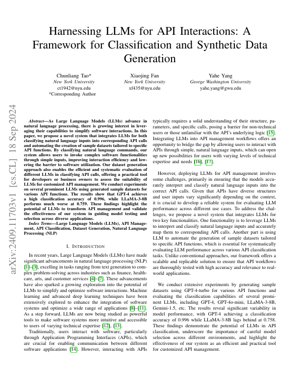
This paper addresses the challenge of making software Application Programming Interfaces (APIs) more accessible by leveraging Large Language Models (LLMs). Traditional API interaction requires technical knowledge of structure, parameters, and specific calls, creating a barrier for non-technical users. The proposed system uses LLMs for two primary functions: 1) Classifying natural language user inputs into corresponding API calls, and 2) Automating the generation of synthetic, task-specific datasets to evaluate LLM performance for API classification tasks. This dual approach aims to lower the barrier to software utilization while providing a practical tool for developers to assess LLM suitability for customized API management.
2. Related Work
The research builds upon existing work in NLP and software engineering, focusing on bridging human language with machine-executable commands.
2.1 LLMs for Natural Language to API Mapping
Previous studies have explored using sequence-to-sequence models and fine-tuned BERT variants for mapping natural language to code or API sequences. The advent of powerful, general-purpose LLMs like GPT-4 has shifted the paradigm, enabling more flexible and context-aware mapping without extensive task-specific training.
2.2 Synthetic Data Generation in NLP
Synthetic data generation, crucial for training and evaluation where real data is scarce, has evolved from rule-based templates to LLM-powered generation. Models like GPT-4 can produce diverse, contextually relevant textual examples, which is leveraged in this work to create datasets for specific API functions.
3. Proposed Framework
The core innovation is a unified framework that handles both the classification task and the creation of its own evaluation benchmark.
3.1 System Architecture
The system consists of two interconnected modules: the Classification Module and the Synthetic Data Generation Module. A central orchestrator manages the workflow, taking API specifications as input and outputting either a classified API call or a generated evaluation dataset.
3.2 Natural Language to API Classification
Given a natural language query $q$ and a set of possible API calls $A = \{a_1, a_2, ..., a_n\}$, the LLM acts as a classifier $C$. The goal is to find the API $a_i$ that maximizes the conditional probability: $a^* = \arg\max_{a_i \in A} P(a_i | q, \theta)$, where $\theta$ represents the LLM's parameters. The system uses few-shot prompting with examples to guide the model.
3.3 Synthetic Dataset Generation Pipeline
For a target API function, the generation module uses an LLM (e.g., GPT-4-turbo) to create a diverse set of natural language queries $Q = \{q_1, q_2, ..., q_m\}$ that correspond to that API. The process is guided by prompts that specify the API's purpose, parameters, and desired variations in phrasing, complexity, and user intent.
4. Experimental Setup & Results
4.1 Dataset Generation Process
Sample datasets were generated for multiple API functions (e.g., weather retrieval, database query, payment processing) using GPT-4-turbo. Each dataset contained hundreds of natural language queries paired with the correct API call label, covering a range of paraphrases and user expressions.
4.2 Model Performance Comparison
Several LLMs were evaluated on the generated datasets using standard classification accuracy.
GPT-4
0.996
Accuracy
GPT-4o-mini
0.982
Accuracy
Gemini-1.5
0.961
Accuracy
LLaMA-3-8B
0.759
Accuracy
4.3 Results Analysis
The results show a significant performance gap between the leading proprietary model (GPT-4) and a strong open-source contender (LLaMA-3-8B). This highlights the critical importance of model capability for reliable real-world deployment. The high accuracy of top models validates the feasibility of using LLMs for precise API call classification.
5. Technical Analysis & Core Insights
Core Insight: This paper isn't just about using an LLM as an API classifier; it's a meta-framework for evaluating which LLM to use for that specific job. The real product is the synthetic data generation engine, which turns the vague problem of "LLM suitability" into a measurable, benchmarkable metric. This is a shrewd move, recognizing that in the LLM era, the ability to create your own high-quality evaluation data is as valuable as the model itself.
Logical Flow: The argument is elegantly circular and self-reinforcing: 1) We need LLMs to understand natural language for APIs. 2) To choose the right LLM, we need task-specific data. 3) Real data is hard to get. 4) Therefore, we use a powerful LLM (GPT-4-turbo) to generate that data. 5) We then use that data to test other LLMs. It's a bootstrapping process that leverages the strongest available model to assess the field.
Strengths & Flaws: The major strength is practicality. This framework offers a immediately usable solution for enterprises staring at a suite of APIs and a dashboard of available LLMs (OpenAI, Anthropic, Google, open-source). The flaw, which the authors acknowledge, is the "LLM-inception" risk: using an LLM to generate data to test LLMs can inherit and amplify biases. If GPT-4 has a blind spot in understanding a certain type of query, it will generate flawed test data, and all models will be judged against a flawed standard. This mirrors challenges seen in other generative domains, like the training cycles of GANs where the generator and discriminator can develop shared pathologies.
Actionable Insights: For CTOs and product managers, the takeaway is clear: Don't just pilot GPT-4 for your API natural language interface. Pilot this framework. Use it to run a bake-off between GPT-4o, Claude 3, and Gemini on your actual API specs. The 24-point accuracy gap between GPT-4 and LLaMA-3-8B is a stark warning that model choice is non-trivial and cost (free vs. paid) is a dangerous proxy for performance. The framework provides the quantitative evidence needed to make that multimillion-dollar platform decision.
6. Framework Application Example
Scenario: A fintech company wants to add a natural language interface to its internal "Transaction Analysis API" which has functions like get_transactions_by_date(date_range, user_id), flag_anomalous_transaction(transaction_id, reason), and generate_spending_report(user_id, category).
Application of the Framework:
- Dataset Generation: The company uses the Synthetic Data Generation Module (powered by GPT-4-turbo) with prompts describing each API function. For
get_transactions_by_date, it might generate queries like: "Show me my purchases from last week," "What did I spend between March 1st and 10th?", "Can I see my transaction history for last month?" - Model Evaluation: They use the generated dataset (e.g., 500 queries across 3 API functions) to test candidate LLMs: GPT-4o, Claude 3 Sonnet, and an internally fine-tuned Llama 3. They measure accuracy and latency.
- Selection & Deployment: Results show Claude 3 Sonnet achieves 98.5% accuracy at half the cost-per-call of GPT-4o, making it the optimal choice. The fine-tuned Llama 3 scores 89% but offers data privacy. The quantitative output guides a clear, evidence-based decision.
7. Future Applications & Directions
The implications of this work extend beyond simple API classification:
- Low-Code/No-Code Platform Enhancement: Integrating this framework into platforms like Zapier or Microsoft Power Platform could allow users to build complex automations using pure natural language, which the system translates into a sequence of API calls across different services.
- Enterprise Software Democratization: Complex enterprise software suites (e.g., SAP, Salesforce) with hundreds of APIs could become accessible to business analysts through conversational interfaces, dramatically reducing training overhead and expanding utility.
- Dynamic API Ecosystems: In IoT or microservices architectures where APIs frequently change or new ones are added, the synthetic data generation module could be run periodically to update the evaluation dataset and re-assess the best-performing LLM, creating a self-adapting interface layer.
- Research Direction - Reducing Hallucination: A critical next step is integrating formal verification or constraint checking, inspired by techniques in program synthesis, to ensure the classified API call is not only plausible but also semantically valid and safe to execute.
- Research Direction - Multimodal Inputs: Future frameworks could accept multimodal queries (e.g., a user pointing at a dashboard element while asking a question) and map them to a composite API call, blending computer vision with NLP.
8. References
- Brown, T. B., et al. (2020). Language Models are Few-Shot Learners. Advances in Neural Information Processing Systems, 33.
- OpenAI. (2023). GPT-4 Technical Report. arXiv:2303.08774.
- Zhu, J. Y., Park, T., Isola, P., & Efros, A. A. (2017). Unpaired Image-to-Image Translation using Cycle-Consistent Adversarial Networks. Proceedings of the IEEE International Conference on Computer Vision.
- Raffel, C., et al. (2020). Exploring the Limits of Transfer Learning with a Unified Text-to-Text Transformer. Journal of Machine Learning Research, 21.
- Schick, T., & Schütze, H. (2021). Generating Datasets with Pretrained Language Models. Proceedings of the 2021 Conference on Empirical Methods in Natural Language Processing.
- Microsoft Research. (2023). The Era of Copilots: AI-Powered Software Development. Retrieved from Microsoft Research Blog.
- Google AI. (2024). Gemini: A Family of Highly Capable Multimodal Models. Technical Report.